Augsburg: Erhard Ratdolt, 1510, vdm: 258
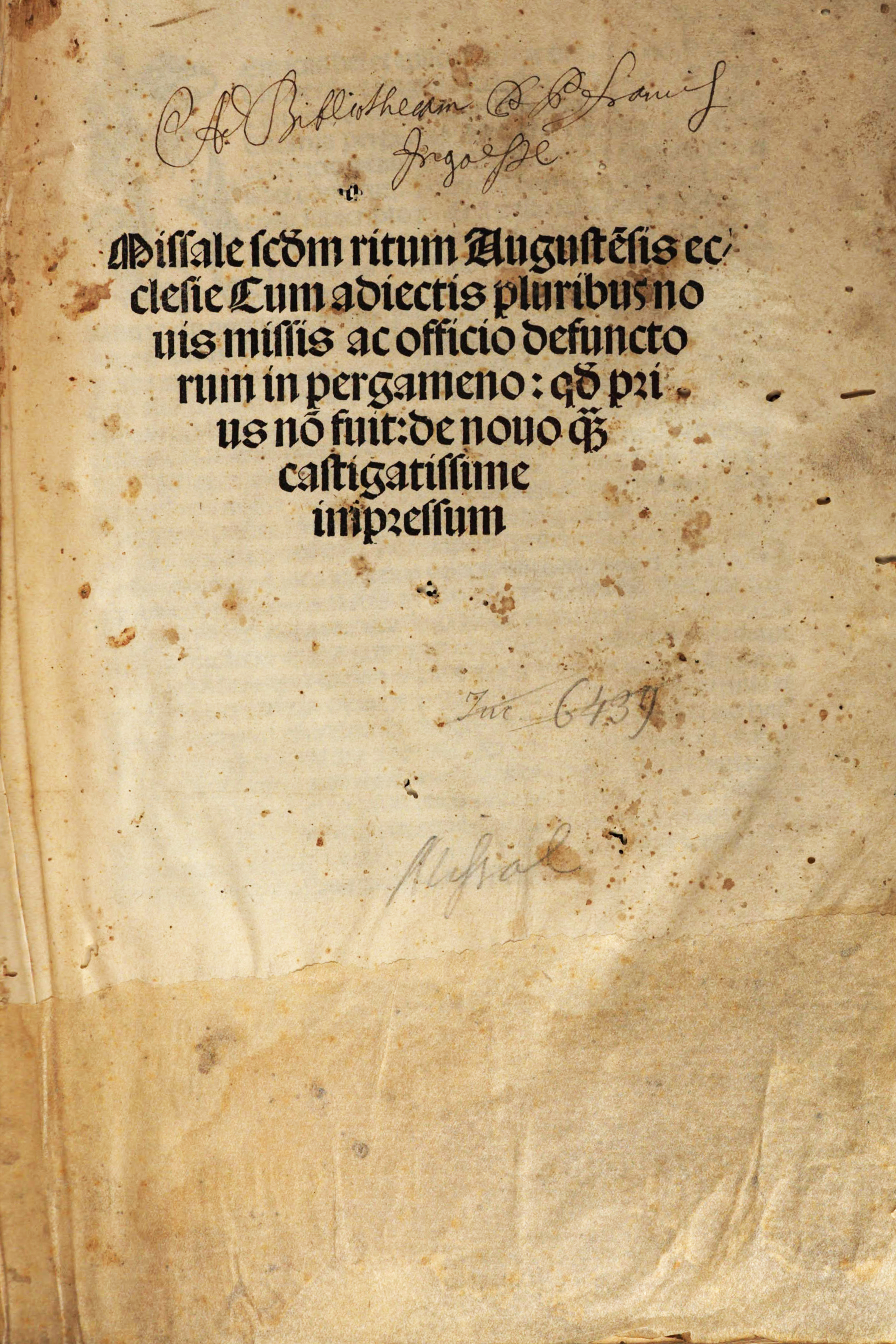
Missale scÄ‘m ritum Augustẽsis ec-||clesie Cum adiectis pluribus no||uis missis ac officio defuncto||rum in pergameno : qÄ‘ pri||us nõ fuit:de nouo q̃ð�”· || castigatissime || impressum ||
fol. CCXXXIIIIr: Liber missalis ẜm ritum ecclesie || Augusteñ. per ErhardÅ« ratdolt || mira imprimÄ“di arte: qua olim || Venetijs: nÅ«c Auguste vindeli-||corum excellit nominatissimus: || Auguste impressus finit feliciter || Anno domini .M.D.x.sexto ka||lendas Aprilis.||

K5r: Ratdolt’s printer’s mark, surmounted by the verses: Erhardi Ratdolt felicia conspice signa || Testata artificem qua valet ipse manum.
Augsburg
Liturgical book
[α]2r: HEnricus dei et apÅ‚ce sedis gratia Ep̃s Augustenẜ || ...
Letter from Heinrich, bishop of Augsburg, dated from Dillingen on 1 February 1510. He mentions the services to the preservation of liturgy done by his predecessor Friedrich. He mentions that he had commanded Ratdolt to print this missal, so that there should be no lack of books and that they should be accurate, consistent with the earlier editions and also elegant (Ne temporum cursu predictorum librorum minuatur: eque castigatos prioribus consonos et non minus elegantes per prouidum nobis in Christo dilectum Erhardum Ratdolt ciuem Augustensem imprimi mandamus).
[α]2v: somewhat crude woodcut of Madonna and child surrounded by SS Ulrich and Afra. Four shields, including the arms of the bishop and the bishopric, are beneath.
s3v: Canon woodcut of crucifix
s4r: Decorated initial T for Te igitur.
s6v: Agnus Dei.
Latin
[14], I–CVIII, [8], CXV–CCXXX, CCXXXI, CCXXXIIII (gathering I [2 leaves]), CCXXIIII, CCXXXI, CCXXXII, [4]
D-Ngm 2º Rl 3302 (Postinc.) (olim 4111); further copies need to be inspected.
Diplomatic transcription of title page taken from D-Mbs 2 Liturg. 185a.
D-Mbs (1)
multiple impression
Rotunda
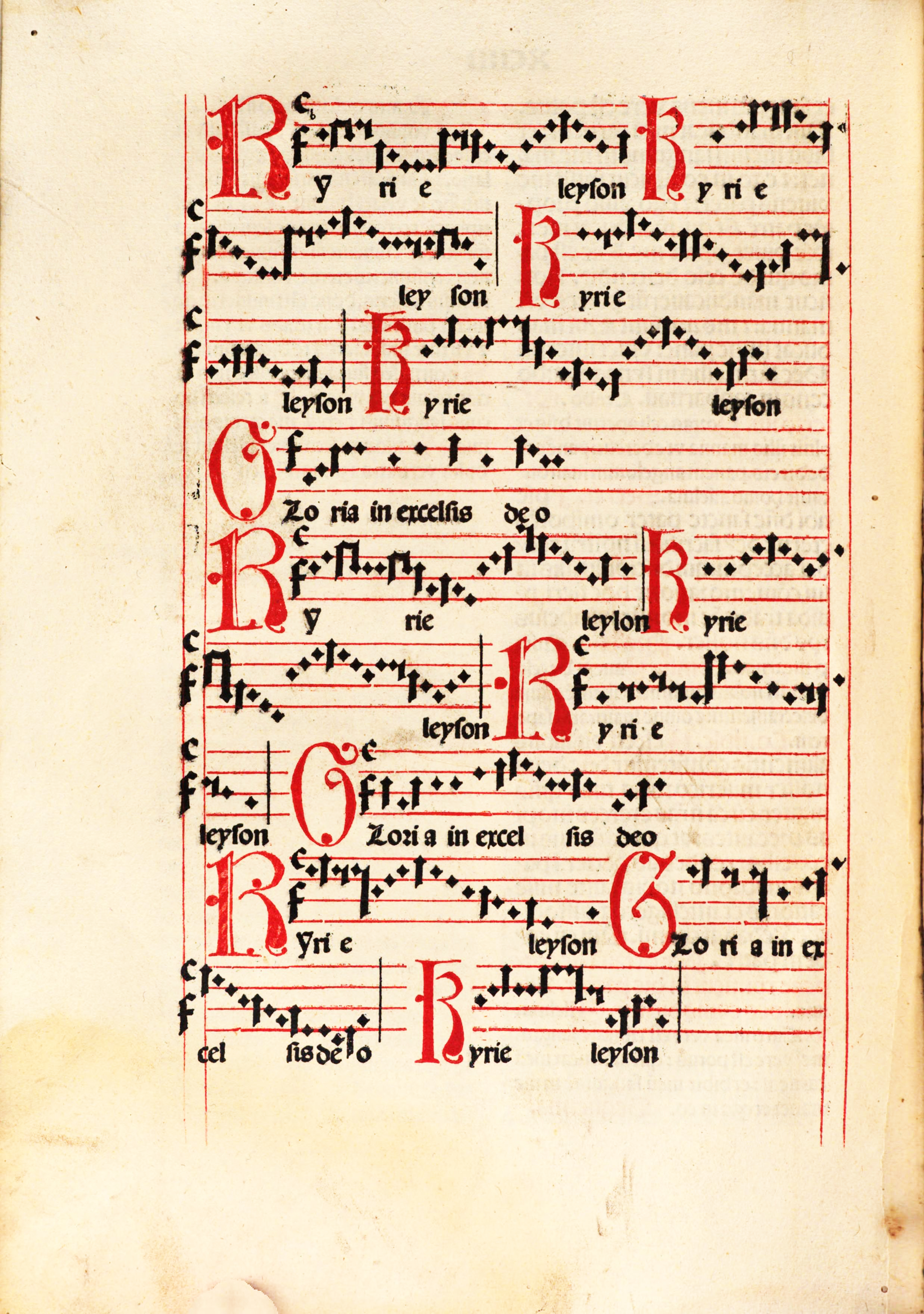
red staff lines, red initials, red text
The full staves are made of six pieces, each 22 mm long, plus one piece 9 mm long. Staves in which an initial occurs also contain yet shorter pieces of staff, 3.5 mm long. There are some shorter staves of one column’s width. The descent of the notes into the region of the text underlay indicates that this book could have been printed in triple impression.
Two columns, 42, 47, 29, 23 lines. Types 9, 11, 12, 13 (Proctor).
Hufnagel notation
Full-length staff: 164.5 x 16.5 mm.
Height of virga one: 8.5 mm; height of virga two: 9 mm; height of virga three: 12 mm; height of virga four: 16 mm.
Black Hufnagelschrift on red four-line staves on m6 and through quires n and o. Ratdolt often gives f- and c-clefs on the same staff.
chant
Kyrie, Gloria intonations, prefaces (in most cases both solemn and ferial) for Christmas, Epiphany, Lent, Easter Vigil, Easter day, Ascension, Pentecost, Trinity, for Marian feasts, Apostles, Palm Sunday/Maundy Thursday and “in Sancta Cruce”, ordinary time; Credo intonations; Pater noster; Pax domini.
A-Iu, *D-As, D-Mbs, D-Mbs, D-Mu, *D-Ngm, F-CHf, GB-Lbl, *GB-Ob, H-Bn, I-TRbc
[Dillingen]: Johann Sensenschmidt, 1489, vdm: 1060 Augsburg: Erhard Ratdolt, 1491, vdm: 1074 Augsburg: Erhard Ratdolt, 1496, vdm: 1086 Augsburg: Erhard Ratdolt, [1500 c.], vdm: 1090 Basel: Jakob Wolff, 1510, vdm: 253
Weale, William Henry James. Bibliographia liturgica: Catalogus missalium ritus latini ab anno MCCCLXXV impressorum. Edited by Hanns Bohatta. London: Quaritch, 1928 (107)
Panzer, Georg Wolfgang. Annales typographici ab artis inventae origine ad annum MD, 11 volumes. Nürnberg: Johannes Eberhard Zeh, 1783-1803 (6:138, 51)
Proctor, Robert. An Index to the Early Printed Books in the British Museum. Part II. MDI-MDXX. Section I. Germany. London: Kegan Paul, 1903 (74, 10651)
Possibly a ghost.
incomplete
D-Mbs (1)
incomplete
Good. Canon printed on vellum. Leather tabs. Foredges gilt in floral pattern.
Hand coloured and gilt woodcuts.
Good.
Printed section (late sixteenth century) with new rubrics from Sunday XXII onwards added at the end. On final leaf of this section is added the text of the Dies irae, signed “1.5.89. Jonas Piscator, Plebanus in Dreßling & Meÿling.” On the rear flyleaf, Piscator has added: “Ad Tempestates repellandas Oratio,” signed 1588.
Jonas Piscator (Fischer?), 1588/89.
“H. W. M.” Letters cut out from sixteenth-century books stuck to front flyleaf, somewhat like a ransom note.
lacks q1, k8
Biblioteca Feininger.