Vienna: Johann Winterburger, 1506, vdm: 678
[a1r:] ¶ Incipit liber missalis ẜm || rubricā ecclesie Saltzeburgē⸗||sis cū oībus requisitis.
fol. 262r: Auxiliante deo & dño nr̃o iesu || christo cui est oīs nostre bone || operatiōis & laboris semꝑ ho⸗||nor & gloria. Missale ẜm cho⸗||rum Saltzeburgeñ: cu𝔷 oībus || requisitis. & alijs multis suꝑ=||additis studiosissime reuisum || correctū & emendatū: in claris⸗||sima vrbe Viennensi austriaca || Impensis & laboribꝰ Ioannis || Winterburger diligentissime || impressum: feliciter explicit.|| Anno salutis. &c. Millesimo || quingentesimo sexto. decima⸗||septima die Mensis Augusti || finem dedit optatum.|| Laus deo ||

Winterburger’s mark in red: upright square, printed in red; circle with cross on the top, in the circle a snake and an arrow, right and left the Initials „I“ and „W“; ornamented background.
Vienna
Liturgical book
starts with calendar and a „Tabula littere dominicalis“, followed by an exorcism, „informatione et cautele observande“ for the priests and a tabula for the Sundays.
[1]v: full page woodcut (unsigned) of the arma Christi, surmounted by SS Rupertus and Virgil.
8r: circles with numbers on black ground; in the middle an eagle (Tabula littere dominicalis). Historiated initials.
Latin
i-clvj, [6, canon], clvij-cclxij
A-Wn 14.861-C, supplemented from D-Mbs Res/2 Liturg. 299
D-Mbs, A-Wn
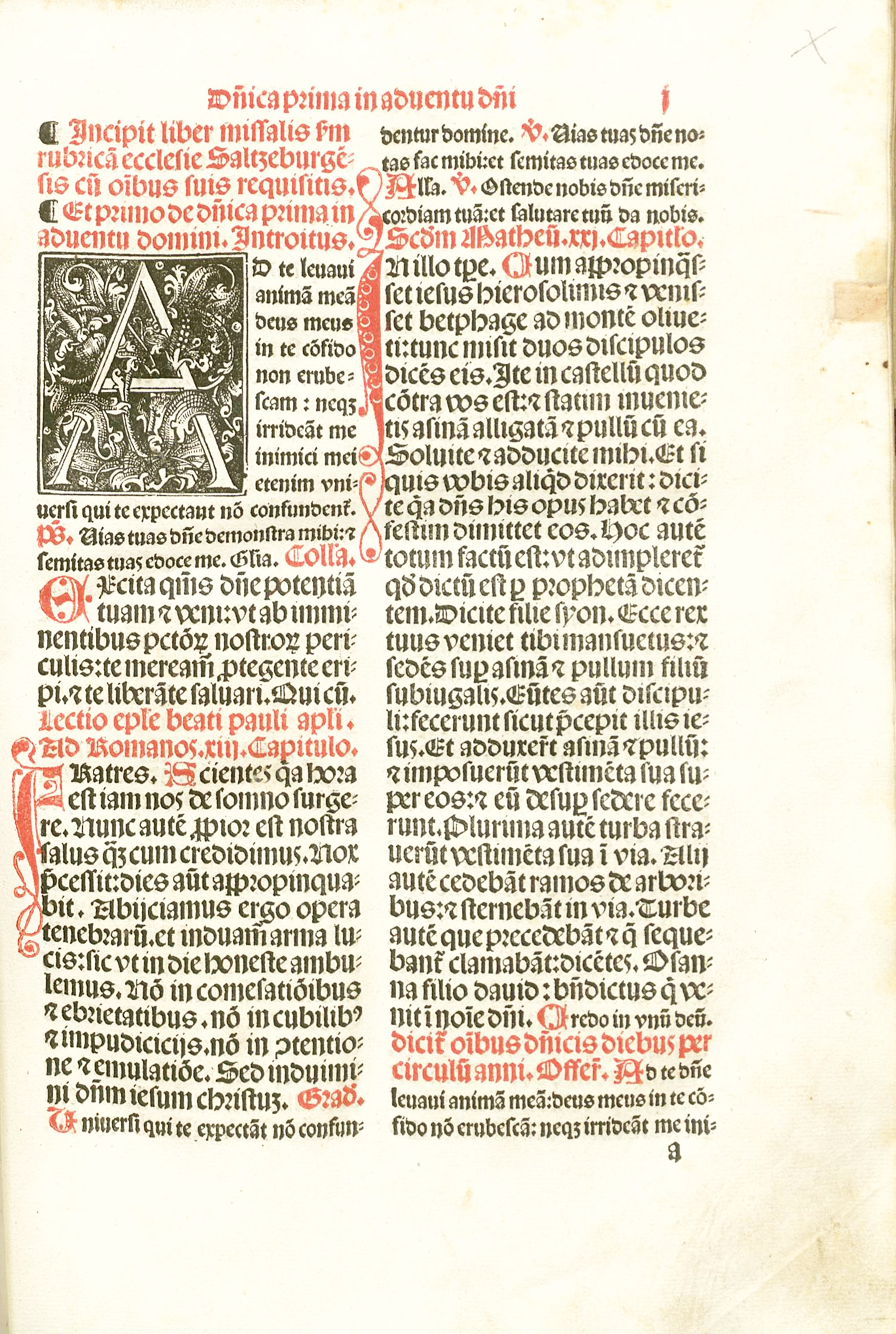
multiple impression; single impression
Rotunda, Uncial
red staff lines, red initials, red text, [other]
There are two different music fonts: a larger and a smaller one that comes in two columns. The staff lines for the smaller font are formed of sections 7.5 mm long; the custos and clef are set on a very short piece of staff 2 mm long, set in each case between two vertical lines. The staff lines of the larger font are made from sections of varying lengths. The Kyriale and the praefationes are printed in two gatherings by themselves (t-v). In the Praefationes (fol. cxliiijv onwards) single notes with their own systems are printed in red (At the head of this section: “In summo fest. // Ad summum festum generalis prefatio. notis rubeis coassumptis. que tamen ad minus festum omittuntur.“)
Hufnagel notation
small fonts: staff lines 74.0 x 10.o mm, virga 6.0 mm and 9.0 mm
big fonts: staff lines 158 x 16.5 mm; virga 8.5 mm
blocks of different lengths
chant
ixr, in gallicantu: „Dominus vobiscum“ „Liber generationis“/ lxxvir-lxxviiiv, Sabbato sancto Pasche: „Exultet“/ cxliijr-cxliiijr: Kyrie cum Gloria (Kyriale)/ cxliiijv-clvjv: Praefationes for several occasions. There is no music in the canon.
A-Gla, A-Gu, A-KN, A-Sca, *A-Su, *A-VOR, *A-Wn, *D-Mbs, GB-Okc, I-Mb
Nuremberg: Georg Stuchs, 1492, vdm: 1396 Nuremberg: Georg Stuchs, 1498, vdm: 1397 Nuremberg: Georg Stuchs, 1505, vdm: 237 Basel: Jakob Wolff & Johann Oswalt, 1510, vdm: 259 Vienna: Johann Winterburger, 1510, vdm: 257
Weale, William Henry James. Bibliographia liturgica: Catalogus missalium ritus latini ab anno MCCCLXXV impressorum. Edited by Hanns Bohatta. London: Quaritch, 1928 (1381)
Boorman, Stanley. “The Salzburg liturgy and single-impression music printing,” In Music in the German Renaissance, edited by John Kmetz, 235-53. Cambridge: Cambridge University Press, 1994
Daschner, Dominik. Die gedruckten Meßbücher Süddeutschlands bis zur Übernahme des Missale Romanum Pius V. (1570). Frankfurt am Main: Lang, 1995
Dolch, W., E. Langer, and I. Schwarz, Bibliographie der Österreichischen Drucke des XV. und XVI. Jahrhunderts. Wien: Gilhofer & Ranschburg, 1913 (56, 42)
Gillion, Marianne C.E. "Archiepiscopal Archetypes, Printed Books, and Parish Practices: Musical Notation in Editions of the ‘Missale Salisburgense’ (1492-1515)." Florilegium 34 (2017): 119–146 (published 2021).
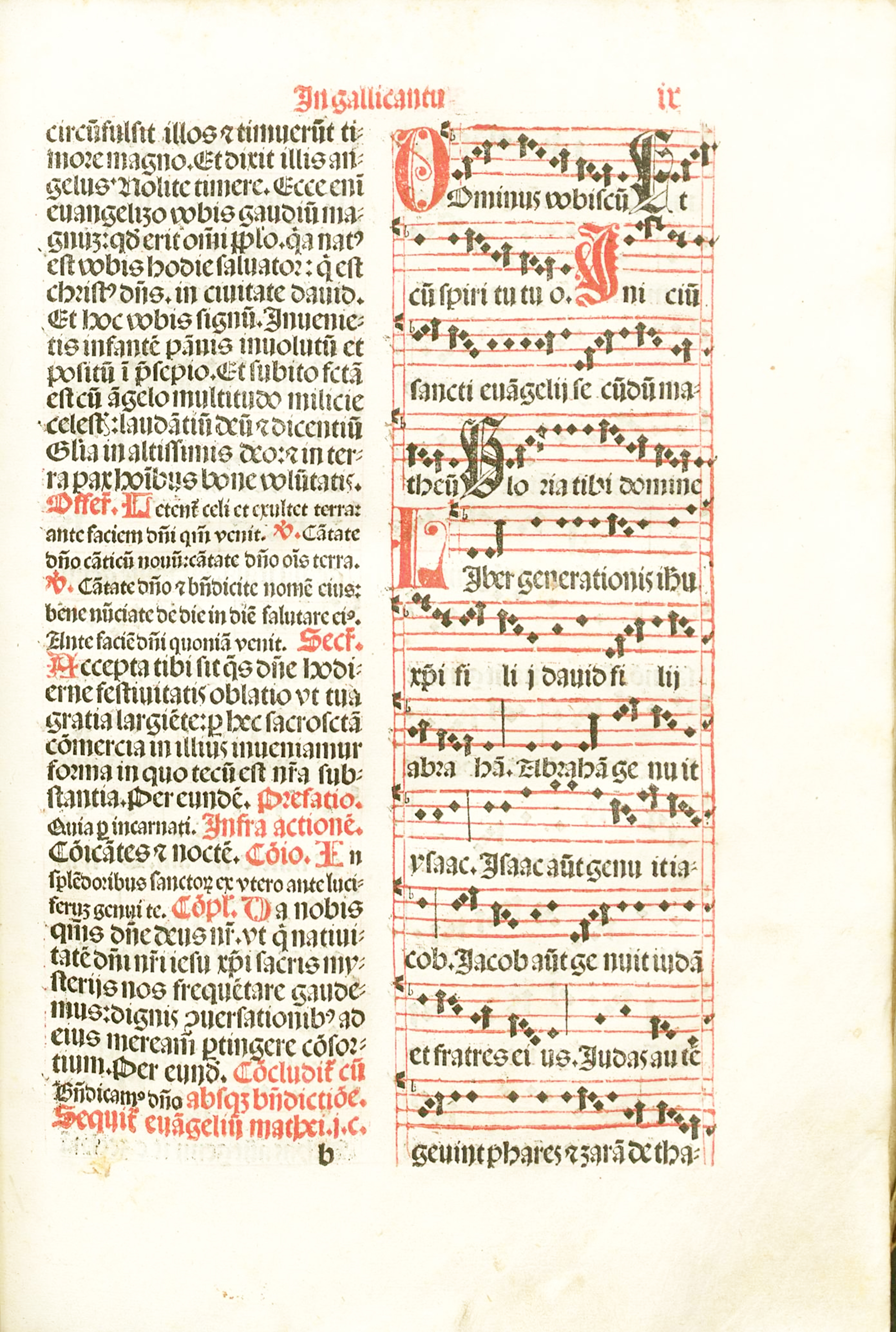
Imperfect.
Imperfect.
Imperfect: title page is missing. Canon printed on vellum, woodcuts hand-coloured and gilded.
On the front flyleaf, an early sixteenth-century hand has copied out the Missa de passione domini.
Hand written annotations in calendar, such as the addition of St Vitalis on 18 October, as well as in the course of the book.
In the music, an early user has inserted small marks to separate the notes to be sung to a single word. On t1v, a later user has added another two incipits for Kyrie and Gloria. On v4r early users have added short rubrics.
From the collegiate church of Berchtesgaden (inscription, fol. ijr).
delicate and wormy. Canon on vellum.
former shelfmark: La 262 / 20
prayers on the back pastedown. Te igitur initial is handcoloured and gilded.
on the pastedown: AS A H 1563 / Andreas Handler
Two extra pages at the beginning and four at the ending of the book with ms. additions; p. 1 gives the names of the priests who used the book at the altar from 1515 to 1587; p. 2 gives the proper texts for „De sancto Joseph“; the last four pages give additional proper texts for several other feasts.
Hand colouring on the woodcut fol. 8r, on the initial on fol. a1 and at the beginning of the canon.
Inscription on fol. 1r at the top: „1541 || Caspar de Kus[h?]enbach prepositus et archediaconius Saltzeburgensis, Collator.“
A-Wn
Imperfect: lacks canon woodcut.
Gilding and colouring to the canon, which is printed on vellum. Tabs. Bound in after fol. CXL is one leaf with the text of the ordinary of the mass in ms (17th century?). Prayers added on rear flyleaf and pastedown. On Front pastedown is a printed notice of an indulgence given by Gregory XIII to priests who say the prayer provided before mass.
Our Lady, Altötting. Note on front flyleaf (sixteenth century): “Diß Mesbuch gehort vnser lieben frawen zu alten Ötingen vnd soll do selbest gebraucht werden in den eren gotß vnd seiner muter Marie. Amen.”
Fol. ijr: “Ad Conventum Seemanshusanum” (seventeenth century).
D-Mbs
Imperfect.