Verzeichnis deutscher Musikdrucke des 16. Jahrhunderts
Catalogue of sixteenth-century German printed music

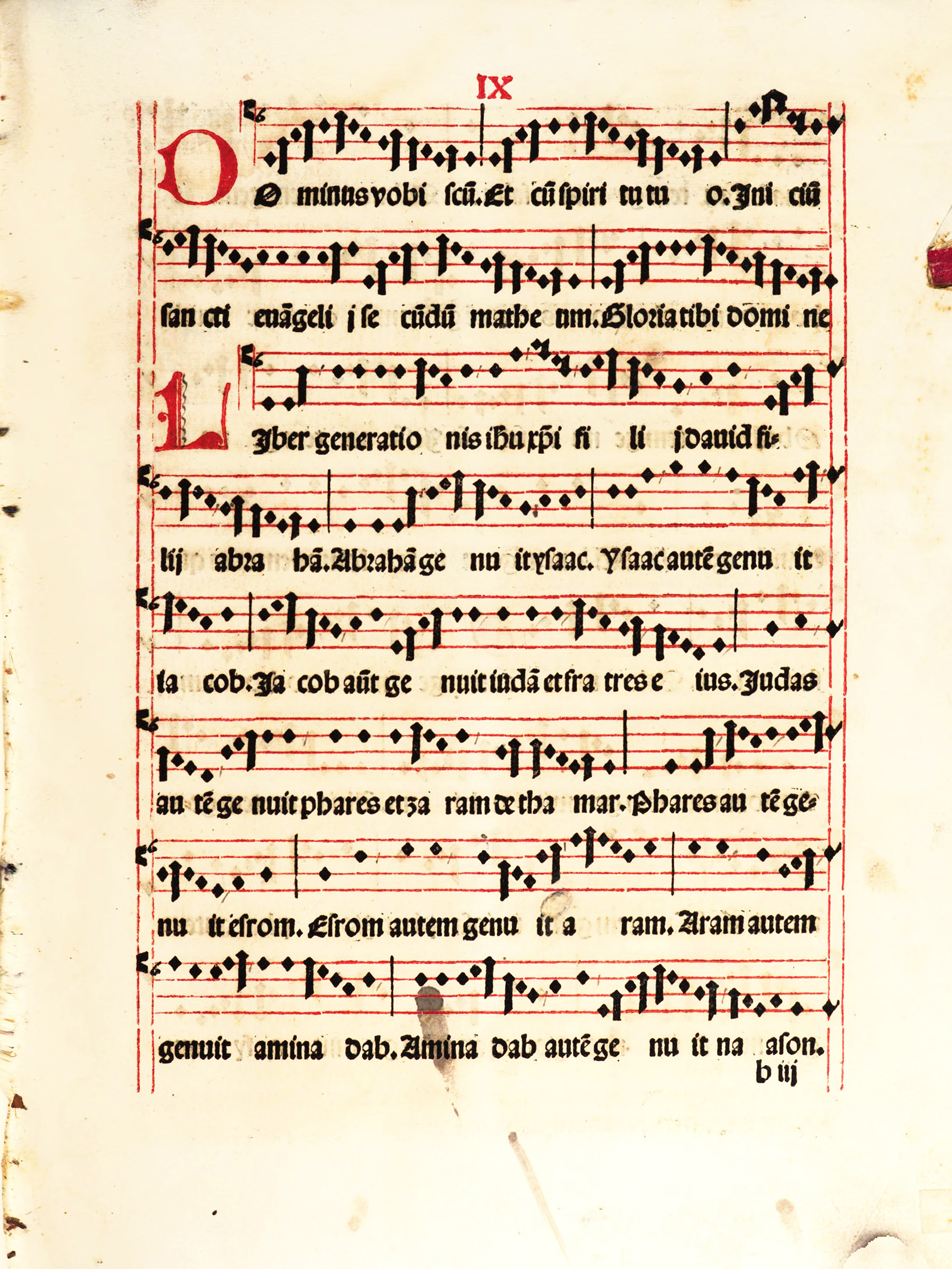
Nuremberg: Georg Stuchs, 1505, vdm: 237
multiple impression
Rotunda, Uncial
red staff lines, red text
This edition does not contain the extra red notes for more elaborate chants, as in vdm 257, although they are announced on fol. t 2v: "notis rubeis coassumptis. que tamē ad minus festum omittunt."
Types 7, 15, 16, 17 (Proctor).
Hufnagel notation

full-length staff: 171 x 12.5 mm; heigh of virga one: 11 mm; height of virga two: 8.5 mm; height of virga three: 7 mm.
chant
IXr-Xv: response and Liber generationis; LXXIVv.LXXVIIIv: Benedictio cerei; CXLIr-CLIVv (gatherings t-v): Kyrie, Gloria, and Credo intonations, prefaces, pater nosters.
Weale, William Henry James. Bibliographia liturgica: Catalogus missalium ritus latini ab anno MCCCLXXV impressorum. Edited by Hanns Bohatta. London: Quaritch, 1928 (1380)
Daschner, Dominik. Die gedruckten Meßbücher Süddeutschlands bis zur Übernahme des Missale Romanum Pius V. (1570). Frankfurt am Main: Lang, 1995
Proctor, Robert. An Index to the Early Printed Books in the British Museum. Part II. MDI-MDXX. Section I. Germany. London: Kegan Paul, 1903 (95, 10965)
Amiet, Robert. Missels et bréviaires imprimés. Supplement aux catalogues de Weale et Bohatta. Paris: CNRS, 1990. (82)
Gillion, Marianne C.E. "Archiepiscopal Archetypes, Printed Books, and Parish Practices: Musical Notation in Editions of the ‘Missale Salisburgense’ (1492-1515)." Florilegium 34 (2017): 119–146 (published 2021).
Duggan, Mary Kay. Printing and Reform. The Beginning of Music Printing in German-speaking Lands in the Fifteenth Century. (under review)